6 THINGS I LEARNT FROM SPENDING 2 YEARS IN A MALAYSIAN PRISON

By
Posted on 06/07/2018
- 2.5KSHARES
- Facebook1.9K
- Twitter50
- LinkedIn86
- Email87
- WhatsApp317
CILISOS has made several articles talking about Malaysian prison in the past, which were quality, but at the end of the day, it’s hard to actually capture what life is really like inside there if you’ve never actually been kept there as an inmate. So, given that I was incarcerated in Sungai Buloh Prison for the last 2 years, and that some of Malaysia’s most prominent people are facing time themselves, I thought I’d lend some perspective and insight into what reallyyyy goes on inside prison.
First, a little bit of context, and I feel that this is important for everyone reading to know: I was only remanded for 2 years there, which means I was never sentenced. Because, as it turns out, you don’t actually have to be guilty of a crime to be sent to prison (read this excellent article on remand by our friends at AskLegal.my). After two LONG years of simply waiting for my case to run its course in a court of law, I was discharged, acquitted, and released.
I have also chosen to remain anonymous for the time being as the case is actually technically still not finished (since 2016 and running!), though I’ll be more open about it once it does. So, you’ve seen the movies. The TV shows. Shawshank Redemption, The Green Mile, Orange is the New Black and whatnot. But how different is Malaysian prison life as compared to what you see on mainstream media?
Veryyyyy different, as it turns out.

For instance, have you ever wondered what happens in the daily life of a Malaysian prison inmate? What we get up to when boredom hits or, to use an old prison expression, ‘muster tak correct’? How inmates light their cigarettes when their lighters run out of gas? Or the tactics prisoners employ to fool the guards?
I’ve combined my own experiences, and some of another former prisoner, Tan (not his real name) to shed some light behind the bars. It sounds crazy, but there are in fact many, many others who are still being remanded there after several years for offences with no bail, such as murder, rape and drug trafficking. Also, not everyone who has been accused and remanded actually did anything wrong… just ask Siti Kasim.
So imagine one day you’re just minding your own business, and suddenly you’re being arrested and accused in court. Before you know it, you’re boarding an overcrowded PDRM lori ayam along with other OKTs (orang kena tuduh/accused) en route to the very-uncomfortable Sungai Buloh Prison, where you’ll be remanded until your case runs in court.

“Can pass the lighter ah bro?” Image from pahang-ku.blogspot.com
And once you arrive, you’ll quickly learn that in prison, people do things a lot differently than you’d be used to outside. Let’s start with something a bit lighter…
1. Malaysian prisons have their own brand of goods
That’s right! Jabatan Penjara actually markets products under their brand ‘Kopen Maju Sdn. Bhd.’!

Image from kopen.com.my
Kopen, which is a combination of the words ‘Koperasi Penjara’, is exactly what its name suggests: a prison corporation which re-packs and sells products from mainstream private corporations (through mutual agreement), as well as its own products in a way that is suitable for prison. These include:
- Chocolate malt powder in clear plastic packs (‘Kopen 3-in-1 Chocomalt’)
- Instant noodles
- Clear PVC slippers
- Assorted biscuits
- Clothes
- Coffee (Kopen Cafe)
- Shampoo and soap
- Washing detergent
- Medicated Powder
- Finger toothbrushes
By re-pack, I mean pack it in a way that prevents inmates from abusing the packages, as per prison guidelines. According to their website (which ugaiz can check out here!), clear PVC slippers prevents inmates from smuggling stuff in outside slippers, and all-plastic packaging ensures inmates don’t use the foil as a ‘pot’ to smoke drugs.
Alongside PERSIAP (essentially the WAGs of prison employees), Kopen helps make a few extra bucks on the side for the prison wardens, as well as making use of the inmate workforce to manufacture the products (not us, but only applicable to sentenced convicts and parolees).
2. The worst thing to be caught with in prison is… a handphone!?
Anyone who’s ever watched a good prison flick will know that illegal items will somehow find a way into prison. The most common contrabands are drugs and tobacco, which are both illegal in prison. But you’ll be surprised to know that the penalties for these, if any, are not as severe as being found in possession of an everyday item: a mobile phone. Caught with a small amount of weed in your room? Meh, who cares? But handphones…?

In fact, Jabatan Penjara actually has an entire unit dedicated to preventing the entry of illegal items, especially handphones. They’re called UKP (Unit Kawalan dan Pencegahan/Prevention and Control Unit), and their duties range from conducting spot-checks, to zone patrols, and also, as their name suggests, breaking up fights or subduing unruly prisoners. Their duties aren’t just limited to within prison; they’re sometimes given outer escort duty, which means you probably saw these guys on TV when Anwar first checked-in to prison, and also when he was released. They are easily identifiable by their maroon berets and camo uniform.
Tan, an ex-inmate, elaborates:
“UKPs are feared and respected because of their role and duties inside. UKPs are the special ops team that handles the control of banned items, fights, riots and the flow of everyday activities. Prisoners have to go through a few processes of checking and which all are closely supervised by UKPs, and if caught, punished by them as well.”

Circled is a UKP in full tactical gear. Image from kosmo.com.my
(NOTE: The guys with bright red berets are a separate elite unit called TTC and are usually called upon to quell major riots. They were founded to prevent more events like the 1986 Pudu Jail Riot, which you can read about here.)
Tan also recalls one of our scarier experiences with the UKP (yes, I was there too):
“One of the worst things to be caught with is a phone. We had a tip-off from some gang members that an ambush was about to take place that night. At 3 am in the morning, about 15 massive UKP guys in Counter-Strike style uniforms thrashed our already dark and unsanitary cell, literally turning everything upside down; what was dry became wet and clean became dirty. They found some weed and tobacco in our cell but just took it and left. However, they found a number of handphones belonging to that gang and beat the living crap out of our friends who were keeping them.” – Tan
But what exactly is these guys’ beef with handphones? Well, it turns out that a handphone is essential for drug businesses in prison, by way of ‘tembak akaun‘ (getting someone on the outside to bank-in money for a contraband purchase). Also, we guess phones with cameras threaten the reputation of the prison, as it allows for contact with the outside world, sometimes to plan horrible things.
“We later found out the reason for their operation: the gang I mentioned were planning a kill with their members outside through the use of phones.” – Tan
So, the policy regarding handphones in prison is: “before they give us trouble, get rid of them.”
3. Yes people do hide things in weird places

A spotcheck of prisoners at Rutan Trengallek – Via YouTube
Now, you may be wondering, “How do they even get all this stuff inside in the first place?!” The answer? A magical thing called the ‘rocket‘. Which is essentially sticking it where the sun don’t shine!

Where the sun don’t shine, courtesy of Your Friendly Neighbourhood Deadpool.
Yes, because of the lengthy scan process at the entrance, prisoners are forced to resort to swallowing and/or ‘rocketing‘. Definitely not for the faint-hearted.
“One of the most common ways is through compact sealing that specific item and swallowing and/or rocketing the item. Most of these items don’t go through unnoticed because of the stages of checks. Firstly, prisoners are required to be patted down from head to toe. Then, we move to naked checking, where we remove all our clothes to be checked. Finally, we go through an x-ray scan and, if not found with any banned items, moved back to block.” – Tan
The repercussions are brutal if any illegal item shows up in the scan. As Tan further explains:
“Prisoners who are caught with banned items (declared or not) are forced to poop it out and, if unable to are tagged as PENYU (because they haven’t laid their ‘eggs’). Penyus are beaten severely before they are isolated to the punishment block Tawakal (small cells) until they can ‘lay their eggs’. Most prisoners that carry large amounts of drugs try their best to get rid of their items unnoticed or withhold their drugs as long as possible until the UKP give up and release them. They do this because of their addiction to drugs and/or risk of being charged for drug trafficking. Penyus that are released from this process are then moved to block Damai where they are cramped into filthy cells for two weeks or until next court date as punishment.”
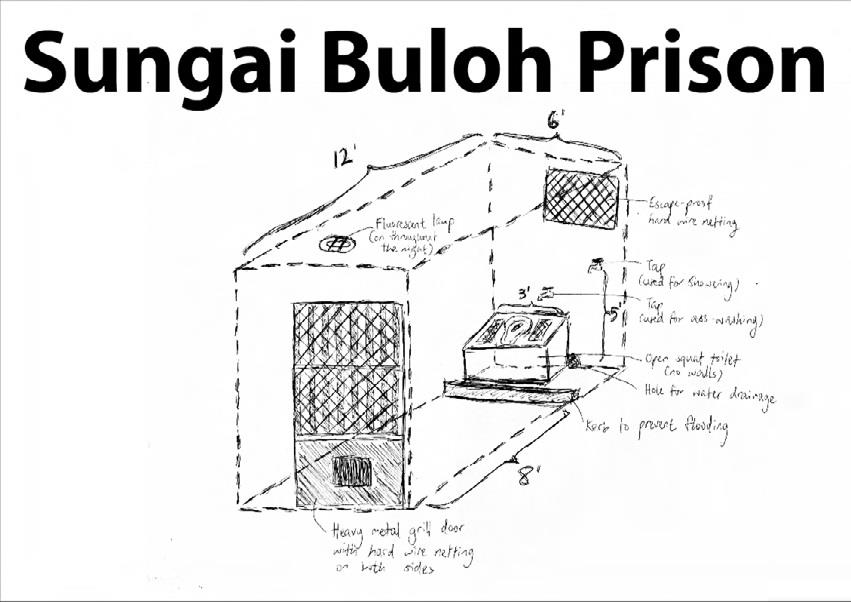
A sketch of the Tawakal cell, made by Alvin Tan (yes, THAT Alvin Tan). Image from thestar.com.my
And that’s just the start of the ingenuity….
4. Prisoners have to resort to MacGyver-like tactics to survive
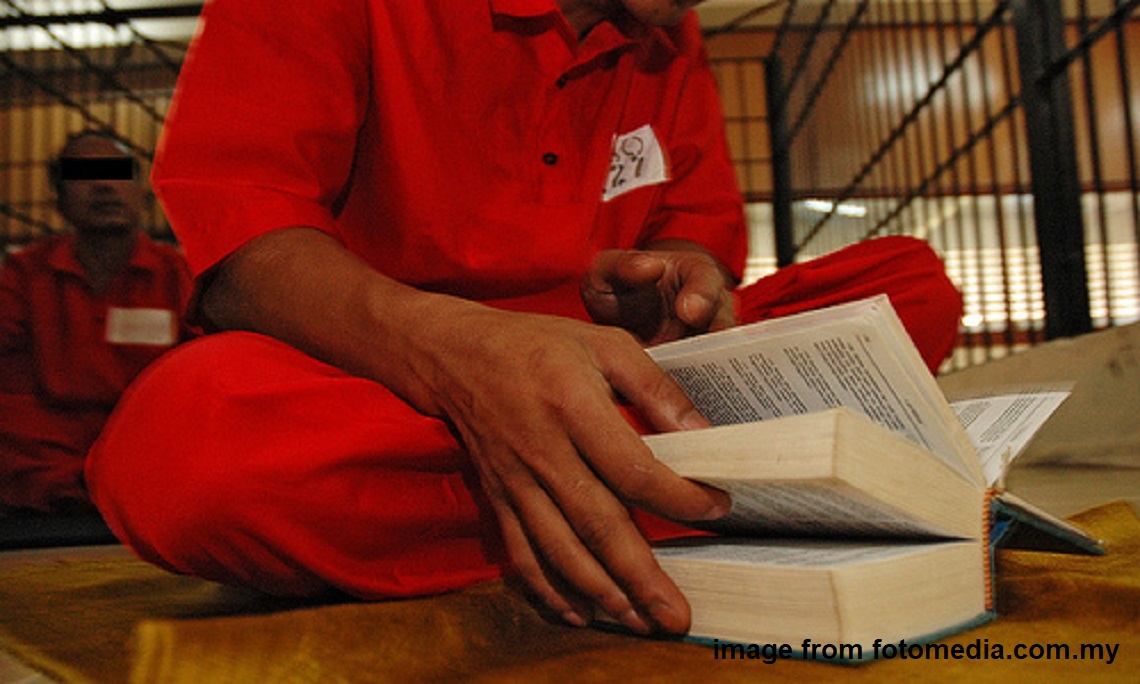
As you’d expect, it gets pretty boring when you’re stuck in a cell the whole day with nothing to do. Besides reading lots of books and smoking yourself to death, there’s really not a whole lot of activities to pass the time. However, with all this free time on our hands, prisoners actually develop ingenious ways of solving problems; an example of which I’ve just given you in the previous point. But besides rocketing/swallowing, what else do inmates get up to to pass the time? Here are some prison survival hacks to make you stand out as a true otai!
i. The Spark
“Because of the limited items found in jail to meet our habits and demands, there are a few skills commonly unknown for people that have never been to jail. One of the most important is the use of a lighter’s ‘spark‘ (the top part of the lighter, no gas required) and cotton from any source (usually denim jeans) to make fire. A spark is an absolutely essential tool (for smoking etc.) and big arguments can occur over these little things.” – Tan
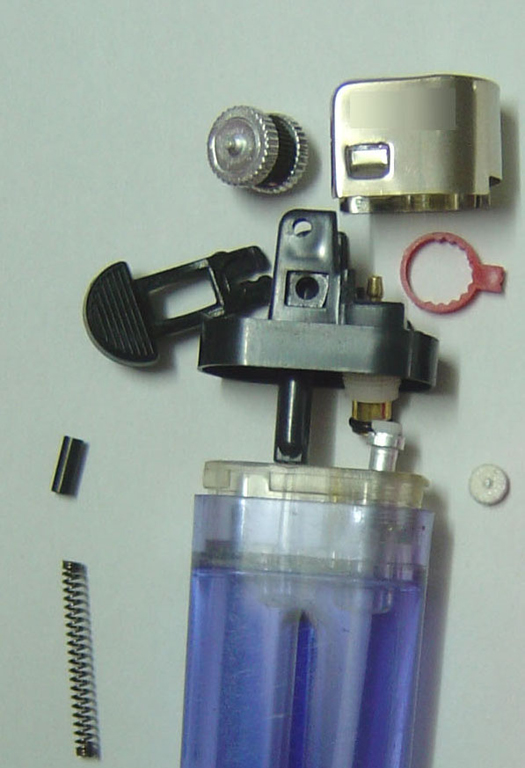
Anatomy of a spark. You only need the housing (the black plastic thingy), roller, grindstone, and the spring to use this. Image from tradekey.com
ii. Pancing/’Fishing line’
By using this brilliant method, inmates can actually retrieve and deliver items to other cells, and even from one landing to another!
“Another would be the use of making and using a ‘pancing’ made from either torn clothes, blankets or stretched plastic bags to pass on anything to other prisoners next door, from one end of a block wing to the other end, or even from the 3rd floor down to the 1st floor! A small weight is attached at the end of this line and then tossed and deftly maneuvered to swing directly into one’s room via the barred window or door.” – Tan
Make your own pancing using this! Image from jayagrocer.com
iii. Charge handphones using… fluorescent lights?!!
You may have wondered how inmates charge their handphones in prison, given that there are no plug points to work from. The answer? A little Kemahiran Hidup know-how and ballz of steel!
“Phones are a risk to have but charging them is another. In jail, prisoners obviously don’t have access of wall sockets in their cells because of its many uses. The most common way prisoners charge phones is from the use of connecting the charger to electricity wires from the fluorescent lights inside the cells, pulling wires from lights outside the cell or from the CCTV cameras in the wings to charge the phone batteries. The wires are live though, so yes, you can actually die if you accidentally touch them.” – Tan
In fact, most of the lights in Sungai Buloh Prison cells have been disabled because people kept using them to charge their phones!
Which begs the question: with all these prisoners constantly driving the UKP and prison guards up the wall with these mad schemes, how well does the prison actually handle these issues? The answer is unfortunately, not so well, and this is largely not the prison’s fault. Because…
5. Malaysian prisons are overcrowded and underfunded

Click to watch two Malaysian prisoners sing the blues
If you’ve read CILISOS’s previous article on prison deaths, you’ll know that Malaysian prisons are dirty and overcrowded, sometimes even to the point of causing death by diseases such as TB and rat urine poisoning. Medicine is a challenge because there are usually more sick people than medicine available. In fact, according to a SUHAKAM (Malaysia Human Rights Commission) report, there were 521 deaths in Malaysian prisons from 2015-16 alone!
Even Tan has seen his fair share of death inside prison:
“During my time inside I was fortunate to be an “orang kerja/trustee”. As an orang kerja I had some privileges that others don’t, most importantly being able to walk around the block. My job was to track and manage movements in and out of the block, and this included medicine and clinic visits. From my experience, rat urine is the most feared poison among inmates, and there were a few people who actually died from this.”
In fact, conditions are so bad that some actually prefer to plead guilty and take the sentence rather than spend more time in remand. Clogged toilets, mouldy food trays, and living amongst the rats and roaches are just some of the things that inmates have to deal with in remand. It’s even worse when you’re in a state that is constantly having water shortages.
“It’s bad. Sometimes the toilets are so clogged that you can’t even pump them out with a plunger. You have to resort to sh*tting on the floor if this happens. The holes are so blocked with sh*t and maggots that most of it has gone hard. If you’re unlucky, you could get a tray with mould on it. Because of the poor hygiene conditions, rats and roaches make their homes everywhere. My God, the smell of the toilets… it will never leave you. The toilets were so bad that they couldn’t be saved with a flamethrower. But the prison is so full and underfunded that there’s not much that the prison staff can do about it either.” – Tan
SUHAKAM has been breathing down the gomen’s neck because of the apparent indifference to requests for more funds, saying:
“In planning the national budget, the government must now use the framework in a human rights-based approach… It must include a participatory process that the community or the stakeholders involved must be a key part of the process… There are small changes to the food quality where the daily food allocation for inmates is increased from RM8 to RM9 but beyond that, we are told that they have not obtained the funds requested.” – Jerald Joseph, SUHAKAM Commissioner after visiting the Ayer Molek police lockup
Which is essentially their way of saying…

Also consider the fact that the starting salary of a prison warden can be as low as RM 827.94 a month, which is peanuts given the fact that most of these people have to feed and raise their families. With such poor working conditions, low pay, and the fact that they have to deal with hardened criminals cooped up in overcrowded prison cells is it really any surprise when stress gets to them and stuff like this happens?
To put the overcrowding situation into perspective, take note that while the prison’s maximum capacity is 3,000, there are often times when it holds up to 6,000 inmates at a time! That’s over 100% over limit (!), and, as you’d expect, not a nice spot to be in if you’ve been accused and remanded. Throw in the occassional water cuts (#SelangorProblems), and the whole block smells for days (cos, you know, no water = no wiping your bum after go-time).
But hey, being close to your fellow inmates is important, because…
6. Being naughty in prison is a team effort
No, we’re not talking about soap jokes, because since homophobia is still quite prevalent in this country, it rarely, if ever, happens in Malaysian prison. So, you can pick up your dropped soap and carry on with your life.


Not in Malaysia. Sorry to burst your bubble. Screencap from YouTube.
I’m talking about the naughty stuff. Namely, contraband items, and the interactions between inmates to obtain them. Not everyone who possesses drugs/tobacco in prison is a consumer. Whether you smoke or not, it’s important to have some of these things because they are prisoners’s unofficial form of currency.
That’s right, you can actually illegally trade with other inmates using drugs of all kinds as well as tobacco. Most of the time you can trade one ‘smokable’ for another (i.e. heroin for weed), but more important is that you can use these things to purchase essential needs and services from other inmates, such as clothes, toothbrushes, towels, slippers, water-dippers… pretty much anything you can think of.
Even tasks like massaging, fanning, washing clothes, and ‘roughing someone up’ can be done, for a price.
They even had their own codenames for all of this stuff:
- habuk (‘dust’) = tobacco
- katte (meaning unknown) = ganja/weed
- panas (‘hot’) = heroin
- sejuk (‘cold’) = ice/methamphetamine

Massage me for one balut? Image from wcmu.org
So the process is this: agree a price, pass him what you promised, and take what you were promised. But the trouble starts when people start cheating others of their stuff, either by not paying enough, or not paying at all. In which case, the matter is usually resolved by:

Screencapped from the PS4 game Uncharted 4: A Thief’s End.
And the best part is if you’re too scared to get your hands dirty, other inmates will usually help you deliver vigilante justice because no one likes a conman! This also applies if a penyu is refusing to give up your stuff, following which your geng will proceed to ‘pump’, which is forcibly trying to remove it either by shoving a small plastic bottle up their bum (this activates the bowels), or making them ingest soap water to induce stomach ache. Now that’s teamwork!

“Look away, kids!” Image from naturallythinking.com
And it’s kinda a weird opposite economy in prison, cos not everyone gets nice family members to visit them. They use the contraband, to purchase everyday items like t-shirts, toothbrushes, soap, and even foodstuffs like instant noodles are, though obtainable legally, difficult to get because you can only get them when your relatives/friends visit you and leave you some cash to buy these from the prison convenience store.
To end, I’ll leave you with a statistic that will get you thinking hard about our prison remand system, and that’s…
25 – 37% of our prisoners are… innocent?!

According to World Prison Brief, in 2015 there was a total of 51,602 prisoners in Malaysian prisons, 25.8% of which (13,000) are remand/pre-trial prisoners.
This means that over a quarter of all prisoners in jail have been incarcerated despite having never been convicted of any crime (FYI it’s 30.4% in Indonesia, and 11.5% in Singapore)! This, alongside the high number of deaths in prison recorded in recent years, is worrying.
Now, this is not to say everyone in prison is innocent, but how are we to establish ourselves as a forward-thinking democracy if we cannot respect the right of a person to the presumption of innocence before guilt??
Although there seems to be no quick-fix solution in sight, the first thing that can be done is to take a serious look into the Malaysian prison system and revamp it so that we can start taking care of people better, even if they are criminals. I’m talking major repair efforts, a better healthcare system, a safer and cleaner working environment for prison employees, and, as a result, happier inmates, because they won’t have to swim in their own poo all the time.
Also, the remand system could be reworked so that the detention periods of OKTs are shortened, or perhaps even done away altogether before they are sentenced, because after all, as mentioned earlier, a person should be presumed innocent before proven guilty, right? Because no matter how big the crime (even if they DID do it), the remand is truly something exceptionally brutal for any human being to have to go through. As our favourite pony-tailed lawyer Fahri Azzat once said:
“It is a fundamental principle of criminal law that a person is presumed innocent until proven guilty… Until he is convicted, you cannot call him a criminal. It follows that you cannot or, more accurately, should not treat him like a criminal… I confess I have never been in remand. But from what I understand and have heard – it is a miserable, depressing and inhumane place.”
- 2.5KSHARES
- Facebook1.9K
- Twitter50
- LinkedIn86
- Email87
- WhatsApp317
RECOMMENDED FOR YOU



INTERNATIONAL
UITM STUDENTS JUST LAUNCHED A SATELLITE INTO SPACE! AND YOU WON’T GUESS HOW MUCH IT COST…

By
Posted on 06/07/2018
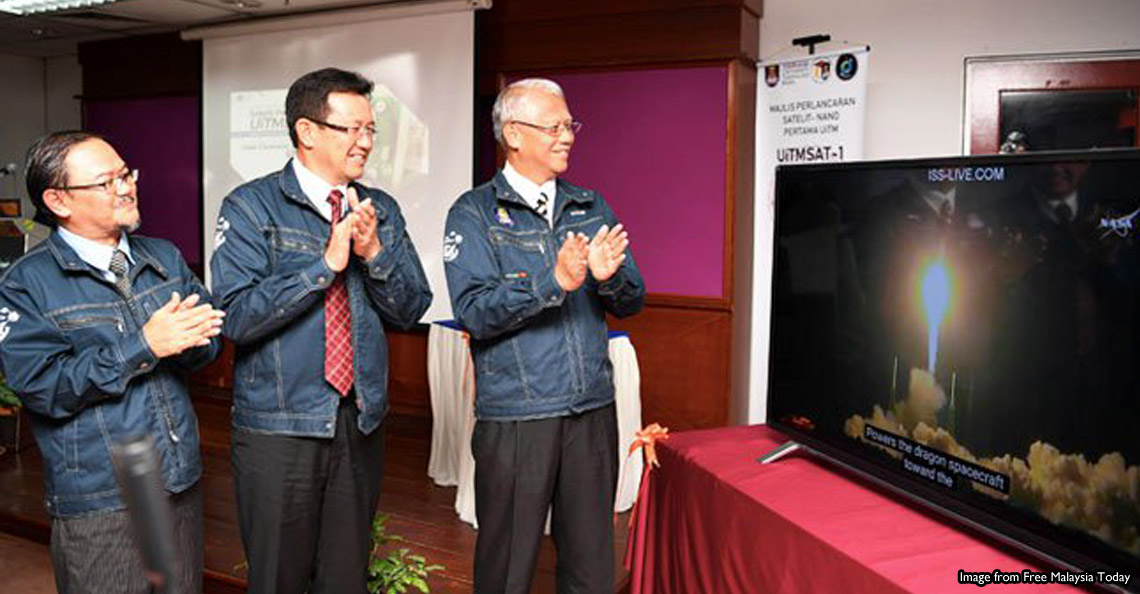
How cool would it be to have your a satellite that you built yourself zipping around in outer space? We don’t know that, but maybe two Universiti Teknologi Mara (UiTM) students do. Syazana Basyirah Mohamad Zaki and Muhammad Hasif Azami, from the Electrical Engineering Faculty of UiTM, was reported to have launched a satellite that they designed and built themselves into outer space last Friday (29th June 2018).
The satellite, named UiTMSAT-1, will make UiTM the first ever public uni to have its own satellite in outer space!
“I think that this is a monumental achievement and it should be the beginning for UiTM to go to the next level and it is hoped that many more high-impact projects can be produced as they will surely benefit the university and the country,” – Prof Emeritus Datuk Dr Hassan Said, UiTM’s Vice Chancellor, translated from mStar.
The launch took the satellite to the International Space Station (ISS), where it will be kept for a while before being released into orbit in August. Once it does, will zip around the earth seven times in a single day, at speeds of up to 28,000 kilometers an hour.
But if you’re imagining one of those large satellites that collect the sun’s rays and fire laser beams to anywhere on earth, well, it’s not quite that la. For starters…
The satellite is smol enough to fit in the palm of your hand
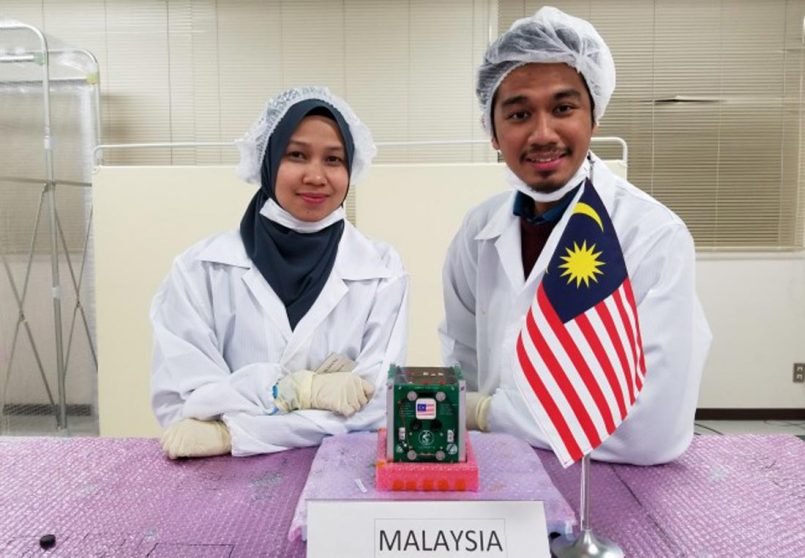
Syazana and Muhammad Hasif, with the UiTMSAT-1. Img from Amanz.my.
For starters, UiTMSAT-1 is kinda tiny. It’s basically a cube measuring 10 cm × 10 cm × 10 cm, which is about the size of an unused toilet roll. Despite the size, the satellite was reported to be equipped enough to handle six missions:
- Capturing images
- Testing satellite location correlation
- Testing of its GPS chip
- Measuring magnetic fields in space
- Collecting geomagnetic mapping data for Southeast Asia
- Radio communications
These missions are expected to benefit some 2,500 of their faculty’s students. It’s impressive what science can do, but tiny square satellites are not really a new development in space science. The concept of CubeSats (satellites with the standard 1000 cm³ shape or a combination of these) had been around since 1999, and as of May this year at least 875 of them had been launched into space. Besides UiTM, another local university had looked into launching satellites of their own.
There were traces of a Universiti Sains Malaysia (USM) project named MYSat, which is also a CubeSat that aimed to collect data from orbit that may help detect earthquakes. The whole project cost was estimated to be around RM25,000, and it was expected to be launched sometime this year. However, we’ve failed to find any other information related to the current status of the project. The last post on MYSat’s social media page had been in January last year.
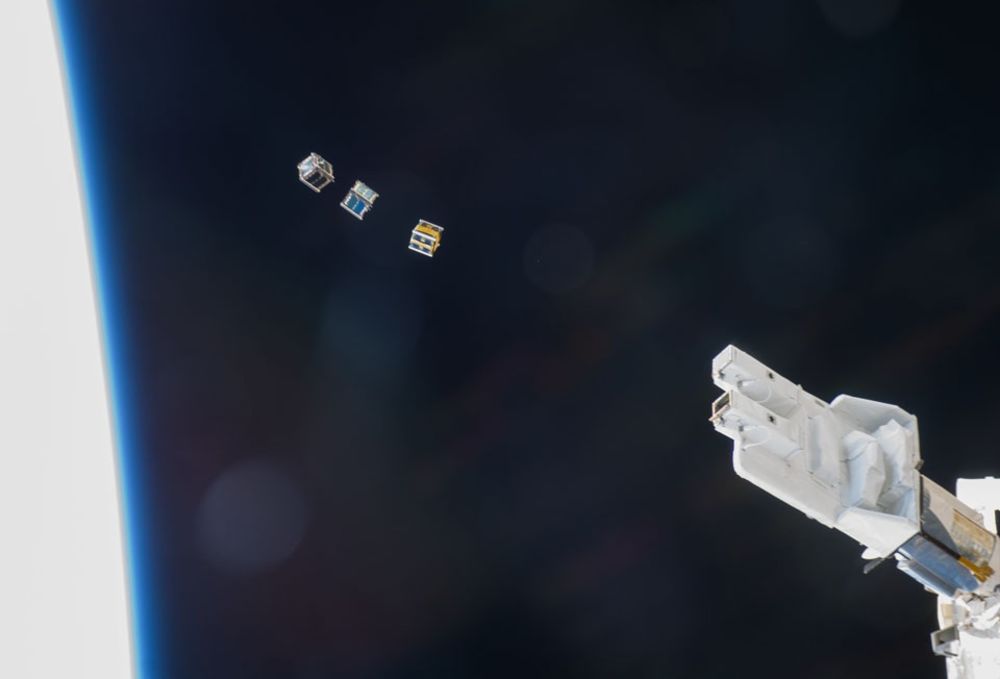
CubeSats being deployed into orbit, but imagine more of them in the background. Img from Popular Science.
Outside of Malaysia, universities, business organizations, corporations, and even elementary schools have managed to successfully build and launch their satellites, for various purposes like education, communication and research. Standardizing the shape and size of CubeSats had made the components for it much cheaper, and constructing a CubeSat had been relatively affordable since.
How affordable, you may ask?
Theoretically, you can have your own working satellite for RM450,000 or less
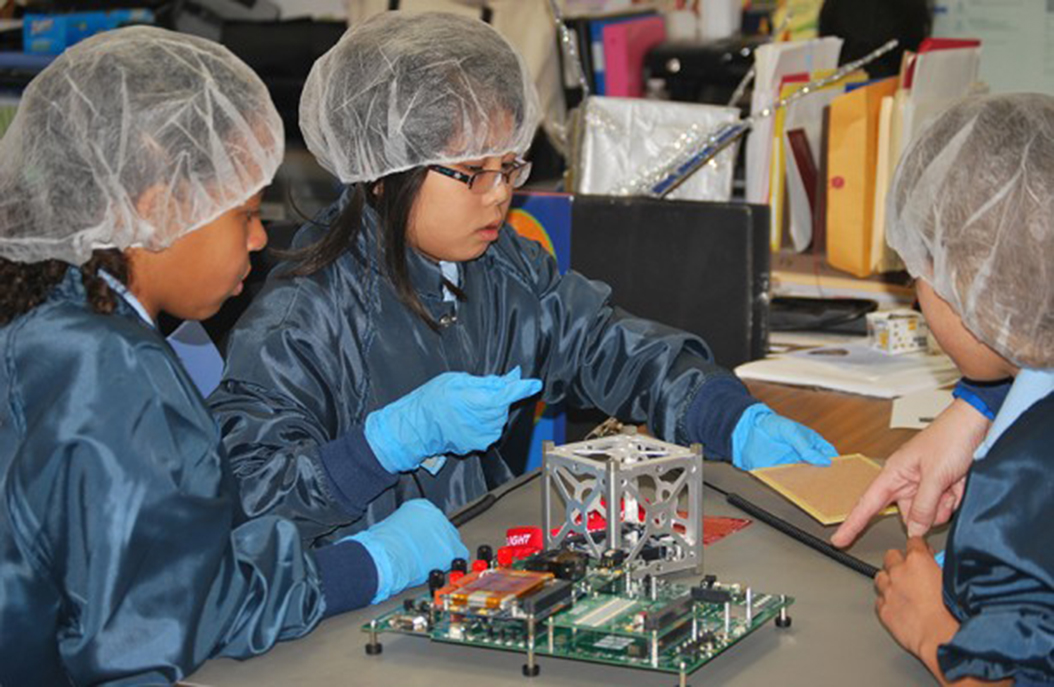
Elementary students from the St. Thomas More Cathedral School in Virginia, US, working on their STMSat-1. Img from NASA.
UiTM’s vice-chancellor Datuk Dr Hassan had quoted the price of the satellite-building materials alone to be around RM500,000, but theoretically it can be less than that. Popular Mechanics have cited the total cost for universities to develop, build and launch their CubeSats to be under $100,000 (RM404,340), but generally the cost of launching your own private satellite is based on three things:
- The satellite itself,
- The cost for getting it into space, and
- A ground station so that your satellite can speak to you.
So we won’t be covering the costs associated with research (if you’re planning on some fancy add-ons to your satellite), airplane tickets, licensing and all the smaller stuff. Anyways, as we’ve said before, CubeSats have gained some popularity over the years, so in a sense people have found a way to make it more affordable and easier to build. There are some sites where you can get yourself a CubeSat kit, and the cheapest one we’ve found cost $7,500, or about RM30,400.
Next you would want a ground station to listen to your satellite, or it will just be a lump of circuits floating in space. If you have a 3D printer or some mad McGyver skills, you can whip one up for under $400 (about RM1,600), using reference from the SatNOGS project. So now that you have a satellite and a ground station, how do you get your satellite into space?
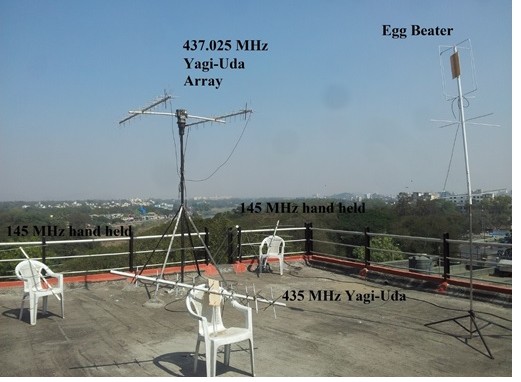
Or you can improvise like these Indian students. Img from Amsat India.
There are basically two options to consider. The first one is getting your satellite on a ride-sharing service into space, offered by private launch companies. Your satellite will be carried into space along with other similar satellites, and some sites estimate the cost to be typically around $40,000 (or about RM162,000). The one company we found will cost around $77,000, or about RM399,900.
Hoo-eee so expensive! But if you’re willing to put in a lot of work, you might try the second option: convincing an agency to let your satellite to hitch a ride on their rockets. Some space agencies, like NASA, may offer to launch your satellite for free if you can convince them that your satellite will benefit science or something. You’ll probably have to look around for this one.
So if you take the cheapest of everything and be a pessimist about NASA not being impressed, we can theoretically launch a private basic CubeSat for about RM432,000, or little less than the price of a 2018 Ford Mustang 2.3 Ecoboost. But still, it all sounds like a lot of work, so…
How on earth did the UiTM students do all of this?
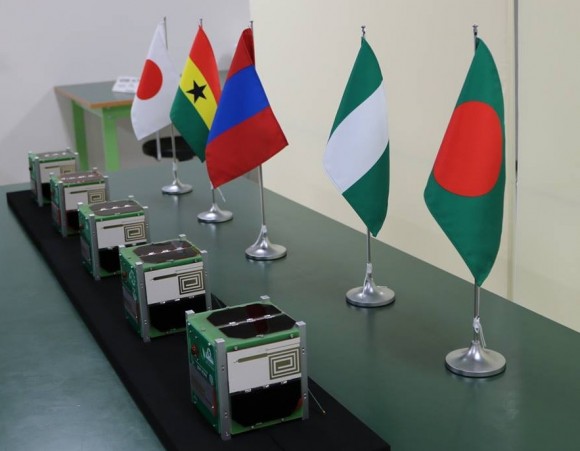
Results from the first BIRDS program. Img from SpaceKate.
Well, they didn’t do it alone. The satellite was built under a program hosted by the Kyushu Institute of Technology (KyuTech), called the “Joint Global Multi-Nation BIRDS Satellite Project” (BIRDS). In this program, Japan basically supports and guides the design and building of satellites by university students from non-space faring countries, and UiTM had participated in the second BIRDS program (BIRDS-2).
The first BIRDS program had been participated by Ghana, Mongolia, Nigeria and Bangladesh, and all five countries (including Japan) built identical satellites and launched them as a constellation (a bunch of satellites linked to each other) in 2017. Besides Malaysia and Japan, Bhutan and the Philippines had also participated in BIRDS-2, and the upcoming BIRDS-3 will be participated by Nepal and Sri Lanka.
As the program had been a collaboration with Japan, the satellites in BIRDS-2 was launched to the ISS together aboard the cargo rocket SpaceX Falcon 9 from Florida, US. So basically it’s more of a joint project rather than a lone achievement. Regardless of that, the purpose of the BIRDS program had been to educate the participants in the process of satellite development all the way from planning to disposal as well as getting different countries to establish a sort of support group in advancing each other’s space programs.
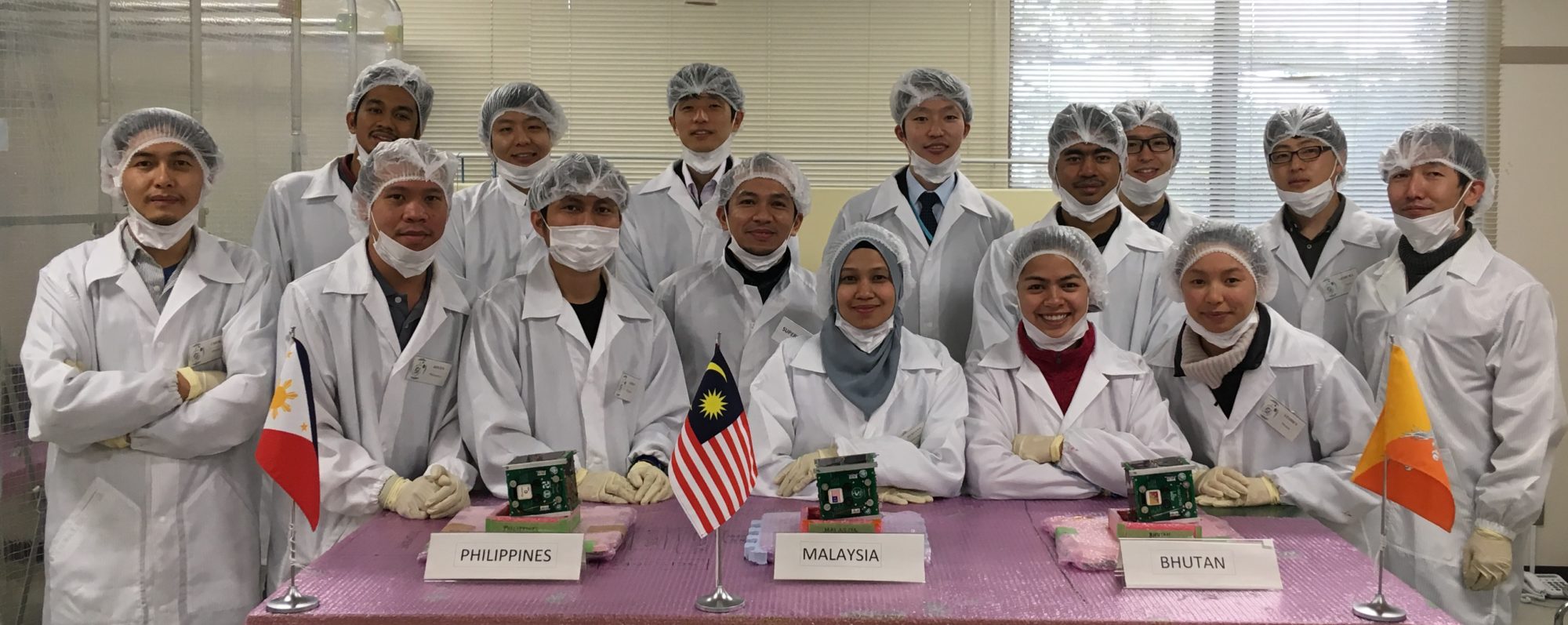
Participants of the BIRDS-2. Img from BIRDS2.
UiTM’s achievement may have come at a good time, as…
It may revive Malaysia’s passion for outer space

We did a thing back then where we asked Malaysians what they would bring to space. Check it out here!
It had long been a dream for Malaysia to advance in the space sector, as evidenced by the establishment of our own National Space Agency (ANGKASA) back in 2002 to lead researches in space science and help the government in drafting a National Space Policy. However, space interest in Malaysia had stretched as far back as 1989, when the Planetarium Division was established under the Prime Minister’s Department.
Since then, Malaysia had accomplished several milestones in space technology, such as launching Southeast Asia’s first space center in 2006, recently completing its National Space Policy, having several satellites up and running, and having sent an ‘astronaut’ into space through its Angkasawan program, although whether we have an astronaut, cosmonaut or a flight participant is up for debate. But in more recent times, things aren’t looking to bright.
Professor Emeritus Datuk Mazlan Othman, Malaysia’s first astrophysicist, had revealed in an interview that our space industry have been regressing. This, she said, can be seen in how we no longer have programs that build our space capabilities and how we are not building satellites.
“The saddest part is that other countries have forged ahead. Around 2004, our space programme was the envy of several countries, especially the African countries. There were even countries that were concerned about our capabilities. But today, some of these countries have surpassed our achievements.“A few months ago, Singapore launched six small satellites, doing the things that I thought Malaysia should be doing. Vietnam is catching up with us. Nigeria has their own facilities. Thailand and Indonesia are ahead of us. We may be trying hard but we have regressed.” – Professor Emeritus Datuk Mazlan Othman, in a 2016 interview with the Perdana Leadership Foundation.
But still, we’re trying. ANGKASA had announced last year that they have equipped themselves with cutting-edge technology to prepare for Malaysia’s space plans. Even outside of ANGKASA, some Malaysians have been making strides in space science, like Nur Adlyka, who co-discovered a supermassive black hole in our cosmic backyard while pursuing her PhD in the UK, and Mohd Izmir Yamin, who heads a team that plans to put a rover on the moon without the government’s help.
While the real star of the BIRDS program had been Japan, with the knowledge and experience gained from the program, the students involved with the UiTMSAT-1 may one day be able to build 100% Malaysian satellites.
RECOMMENDED FOR YOU


FOOD
CACING FOUND IN 8 DIFFERENT SARDINE BRANDS? HERE’S HOW THEY ENDED UP THERE IN THE FIRST PLACE

By
Posted on 05/07/2018

Be it home-cooked or tapau food, instant noodles or canned food, Malaysians are verrrrryy particular about the food we consume. So, when we come across news like how some canned sardines are contaminated or suddenly get an unpleasant surprise in our food, of course we will be outraged.
However, news on contaminated canned sardines aren’t exactly new. In April 2018, the Health Ministry recalled two canned sardine products from China after they were found with dead worms. Those brands were TLC Sardines in Tomato Sauce and TL Tan Lung Canned Sardines in Tomato Sauce.
And recently, The Star reported another SIX products contaminated with worms. The products are sardine brands from Cinta, Sea Brand and HS Brand besides mackerel fish in tomato sauce from King Cup, Star Cup and TC Boy brands.
But this time around, it was reported that these products are contaminated by worms from the genus Anakin Anisakit Anisakis spp.

Anakin also cannot pronounce. Photo from deviantart/trueinnovator159
If these worms live in the sea, how did it end up inside humans?
Yea, yea, we know how alien Anisakis (pronounced as a-ni-sa-kis btw) sounds. Basically, Anisakis is a parasite worm whose life cycle involves fish and marine mammals.
These worms aren’t your regular cacings in the soil that you can find behind your backyard. Apparently, a French biologist named Félix Dujardin created the genus (genus basically means group) Anisakis in 1845. Based on his book which was written in French (sorry, we dunno French so cannot help translate everything for ugaiz), Anisakis was created as a subgenus of another worm called the genus Ascaris Linnaeus.
And just like any living things, Anisakis has a life cycle and, apparently, a complex one too. This is because they go through a lot of hosts through the course of their lives.

Life is tough even for a worm. Image from forum.encyclopediadramatica.rs
So, here’s how the life cycle goes. The worms’ eggs are hatched in seawater and the larvae are eaten by crustaceans, usually krill (those tiny prawns). The infected crustaceans will then be eaten by fish or squid.
Inside the infected fish or squid, the worms will burrow into the the walls of their gut and encyst in a protective coat. This usually happens outside of the internal organs but occasionally in the muscle or beneath the skin.
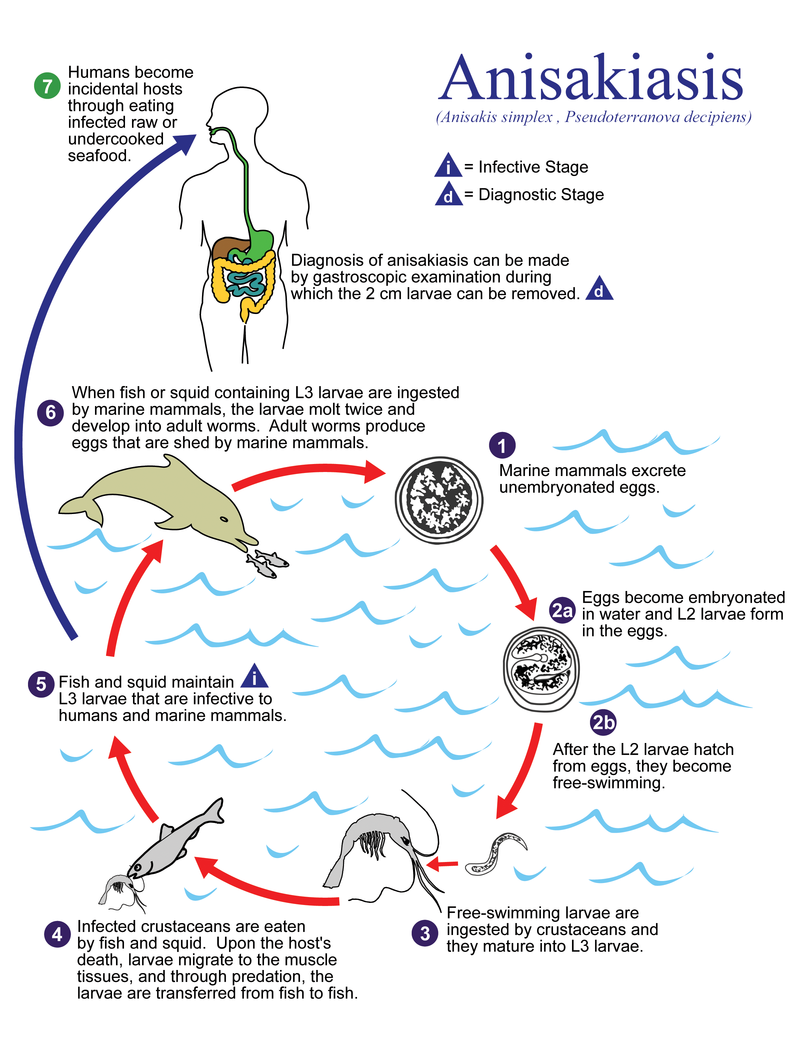
The life of Anisakis, the worm. Image from Wikipedia
The life cycle is completed when an infected fish is eaten by marine mammals like sea lions or seals. The worms would live their normal lives in the intestines, feed, grow, mate and release their eggs (back) into the seawater through… wait for it… their host’s poop.
Basically, these worms are supposed to get back to the sea where they came from but when infected fishes get caught by fishermen for human consumption, problems such as contaminated canned food and diseases will arise.
It was reported that Anisakis can only be found in marine fish. It makes sense why they were found inside those canned sardines and mackerels. So, if ugaiz are fans of sardine, tuna or salmon, you might wanna be cautious the next time you consume them.
So, what happens when you accidentally eat it?
We mentioned how the worms’ eggs were supposed to be released back to the sea. But what happens if humans eat an infected fish? Humans don’t pangsai at the sea, do we?
Since the gut of a human being is functionally similar to a marine mammal’s, these worms can infect humans who eat raw or under-cooked fish. Humans who are infected by these worms would either suffer from Anisakiasis disease or allergic reaction.
Anisakiasis disease generally affects the gastrointestinal tract aka your stomach and intestine. The disease was first reported in the 1960’s, 100 years after the genus was first established, in Netherlands.
The name of this disease might sound scary but basically you might get a bad stomach ache and… bloody poop. When the worms enter your intestine, they will try to penetrate it. Unfortunately for those worms, they will get stuck at the intestine and die since they can’t penetrate it.
This would trigger your immune system to form a ball-like structure around those dead worms and block the digestive system. And this is how you get stomach pain, everyone!

The look when you have to bear with the pain. Image from Wikipedia
This disease is common in countries in the Northern Hemisphere such as Japan (with their sashimi) and Netherlands (with the consumption of cod liver). And since people infected with Anisakiasis normally feel stomach pain, it can be easily misdiagnosed as other diseases like appendicitis or gastric ulcers.
Allergic reaction, on the other hand, affects specific people. Only people with Immunoglobulin E type of antibody would kena this allergic.
But just like any allergic reaction, people who suffers from this type of allergic reaction also suffer from rashes with with red and itchy bumps called Hives. But sometimes, they can suffer from a more serious allergic reaction called Anaphylaxis that might cause death.

Hive rash (on the left) and a more serious rash, Anaphylaxis (on the right). Images from Wikipedia by James Heilman, MD
Aiyo, die la I ate the worms already! How la?
As if finding a worm isn’t unpleasant enough, learning about its entire existence and the diseases it can infect humans might sound rather scary. But, fret not, even the Health Ministry’s director-general, Datuk Seri Dr Noor Hisham Abdullah informed people that the health risk in getting infection is ‘very low’.
In fact, Anisakiasis might not be as critical in Malaysia. A group of researchers from Universiti Malaya and Sunway Medical Centre reported to have found the first case of this disease in Malaysia in 2016.
The case involved a 64 year old man who ate empurau fish from Sarawak to be cooked in KL. After 30 minutes of eating the fish, he experienced stomach pain and passed out stool mixed with fresh blood twice. He also admitted to have eaten sushi (which was the actual cause of his pain) 2 days prior to this incident.
Fortunately, these infections can be treated. In some cases, the infection resolves with only symptomatic treatment. In other cases, infection can lead to small bowel obstruction which require surgery. But at times, surgery can be avoided if patients consume a medicine called Albendazole.
Aiyo, die lorh like that! Isn’t there any way to prevent ourselves from being infected?

Experts (not this girl btw) are telling Malaysians to calm down. Original image from Fotolia
A lecturer at the Institute of Tropical Aquaculture, Universiti Malaysia Terengganu, Associate Professor Dr Marina Hassan told NST that the parasites would eventually die through a process that uses a high or freezing temperature, or appropriate preservation methods.
“However, if marine organism-based food, such as fish and oyster are eaten raw or half-cooked, then the risk of infection may be higher.” – Associate Professor Dr Marina told NST.
So, the best way to eat these marine fishes is probably by cooking them at 60°C. Or else, we could freeze them at −20°C as it also helps kill the worms. And while Associate Professor Dr Marina suggested that appropriate preservation methods would help kill these worms, the researchers from Universiti Malaya and Sunway Medical Centre found out that salting marine fishes does not kill the worms.
However, cooking and freezing can only prevent humans from getting Anisakiasis disease. Allergic reactions will happen even though the fish is thoroughly cooked. But, at least we get to control how we consume these fishes.

This might not be the best time to eat sashimi. Image from Science Alert
And speaking of control, the Health Ministry is also taking action against the companies involved with the case of contaminated canned sardines. Not only did the ministry ordered the products to be withdrawn from the market, it also imposed a ‘Seize, Test and Release’ action.
Imported products will have to go through this action and could only market their products in Malaysia once the samples taken from them are analysed thoroughly. If the sample shows no sign of contamination, the products can be released to the market.
The ministry also added that it would inspect all production plants as a quality control effort over locally produced canned sardines and mackerels.
So, we might wanna be wary with the food we eat at the moment. But, maybe just don’t panic too much lah.